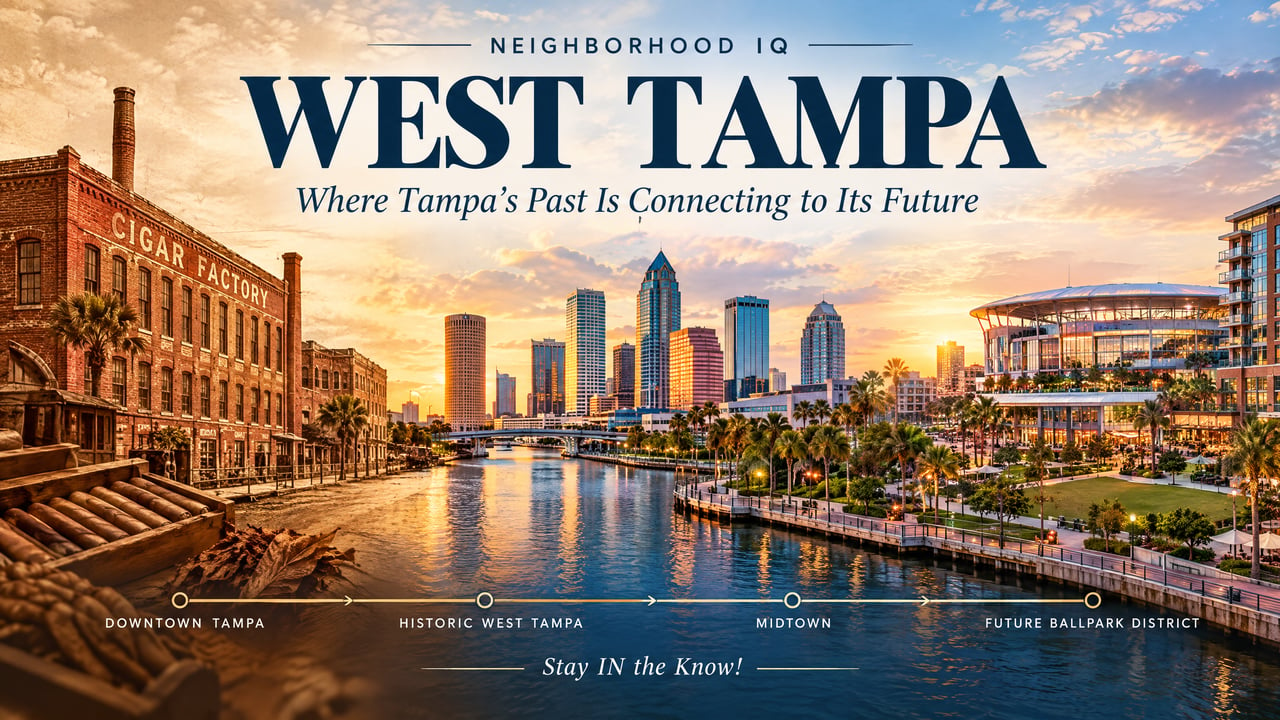
WEST TAMPA: Where Tampa’s Past Is Connecting to Its Future
Neighborhood IQ | Stay IN the Know!
Every neighborhood has a story. But few Tampa neighborhoods have a story quite like West Tampa.
Long before Tampa became known for waterfront towers, professional sports and billion-dollar developments, West Tampa was building an identity of its own — one shaped by immigrants, cigar factories, neighborhood businesses and families who created a community on the west bank of the Hillsborough River.
Today, more than 130 years later, West Tampa may be entering another defining chapter.
Major public and private investments are reshaping the area. The West Riverwalk is extending Tampa's waterfront network. New housing and redevelopment are moving forward. Improved pedestrian and bicycle connections are being built. And just to the west, plans for a new Tampa Bay Rays ballpark and mixed-use district could dramatically change this part of Tampa.
To understand where West Tampa may be going, however, you first have to understand where it came from.
BEFORE WEST TAMPA WAS TAMPA
West Tampa's story begins in the early 1890s with Scottish immigrant, attorney and real-estate developer Hugh Macfarlane.
Macfarlane saw what cigar manufacturing was doing for Ybor City and envisioned another cigar-producing community on the opposite side of the Hillsborough River. He and his partners assembled land, offered incentives to cigar manufacturers and helped provide the transportation infrastructure necessary for workers and businesses to reach the new community.
By 1892, cigar manufacturing had arrived in West Tampa. The community grew rapidly and was incorporated as the City of West Tampa in 1895.
This wasn't simply another Tampa neighborhood.
West Tampa was its own city.
It had its own government, businesses, commercial district and identity before eventually being annexed into Tampa at the beginning of 1925.
THE OTHER CIGAR CITY
When people think about Tampa's cigar history, Ybor City usually receives most of the attention.
But West Tampa was a cigar powerhouse in its own right.
Cuban, Spanish and other immigrant families settled here, while cigar factories became the economic engines around which the community developed. At its height, West Tampa was home to more than 100 cigar factories of various sizes.
The industry influenced almost everything around it.
Workers needed homes. Businesses opened to serve them. Social clubs became gathering places. Streets filled with neighborhood stores and restaurants. Generations of families established roots here.
Even today, some of those enormous brick cigar factories remain part of the West Tampa landscape — physical reminders that Tampa's cigar story extends well beyond Seventh Avenue.
A City of Tampa historical publication notes that nine of West Tampa's original brick cigar factories were still standing when the history was documented.
And that history matters because West Tampa isn't being created today.
It's being rediscovered.
THE RIVER IS BECOMING PART OF WEST TAMPA AGAIN
For decades, the Hillsborough River could almost feel like the dividing line between Downtown Tampa and the neighborhoods to its west.
That relationship is changing.
Construction is underway on the West River BUILD Project, one of the largest infrastructure investments in this part of Tampa.
The project includes approximately two miles of new West Riverwalk along with roughly three miles of roadway improvements, including work along Platt Street, Rome Avenue and Columbus Drive.
The riverwalk portion follows the west bank of the Hillsborough River and connects with Tampa's existing Riverwalk system. When the broader network is completed, the city says Tampa will have approximately 12.2 miles of continuous multi-use pathway connecting communities along both sides of the river.
The investment is approaching $60 million, supported by federal funding, the West Tampa Community Redevelopment Agency and other city funding sources. Construction is expected to be completed in 2027.
But this is about much more than building a sidewalk next to the water.
It is about connectivity.
CONNECTING WEST TAMPA TO THE REST OF THE CITY
Think about Tampa's growth over the last decade.
Downtown.
Water Street.
Armature Works and Tampa Heights.
Hyde Park.
Westshore.
Midtown.
These successful districts don't exist in isolation. Increasingly, Tampa is trying to connect its urban neighborhoods through trails, sidewalks, bicycle infrastructure, parks and complete streets.
West Tampa sits almost directly in the middle of that map.
The West River project will connect Downtown with West Tampa, Tampa Heights, Hyde Park, North Hyde Park, Riverside Heights, Bayshore and other neighborhoods through a larger multimodal network.
One especially important piece is Rome Avenue.
Planned improvements along Rome run from Platt Street north toward Columbus Drive, creating a lower-stress north-south bicycle and pedestrian route through West Tampa.
That strengthens the larger east-west story: Downtown and the Riverwalk on one side, West Tampa in the middle, and the Midtown/Westshore side of Tampa farther west.
It doesn't mean you will suddenly walk out of Midtown directly onto the Riverwalk. But Tampa's transportation investments are gradually creating a much more connected urban network than existed here a generation ago.
And connectivity has historically been important to real estate.
INVESTMENT IS MOVING WEST
The Riverwalk isn't happening by itself.
West Tampa is a designated Community Redevelopment Area, and the city describes the neighborhood's location between Downtown and the Westshore business district as a major reason for continued redevelopment interest.
Another major project is Rome Yard, an approximately 18-acre city-owned property near the Hillsborough River.
The redevelopment vision includes housing at multiple affordability levels along with community-focused features such as a cultural and arts component celebrating West Tampa's history and workforce-development facilities.
That's an important distinction.
Growth doesn't have to mean erasing the neighborhood that was already there.
West Tampa's greatest long-term asset may actually be the combination of the two:
new investment + authentic history.
AND THEN THERE'S BASEBALL
The biggest potential catalyst may be coming just a few miles west.
The Tampa Bay Rays and local governments have moved forward with agreements for a new ballpark and surrounding mixed-use district at the Hillsborough College Dale Mabry campus, near Dale Mabry Highway and Tampa Bay Boulevard. Hillsborough County approved the development and funding agreement in August 2026.
The proposed project is much larger than a baseball stadium.
Plans envision the ballpark as part of a broader mixed-use district incorporating development and a reimagined Hillsborough College campus. County officials have described approximately $8 billion in associated private-sector investment, while the ballpark itself has been reported at roughly $2.3 billion.
The Rays currently anticipate opening the ballpark in April 2029.
That places another major destination immediately west of historic West Tampa.
Consider the geography:
Downtown → Hillsborough River → West Tampa → Midtown → Raymond James / Dale Mabry → Proposed Rays District → Westshore
That corridor could look very different ten years from now.
GROWTH ALSO BRINGS IMPORTANT QUESTIONS
Investment doesn't automatically benefit everyone.
West Tampa residents have raised concerns about affordability, displacement, transportation, preservation and whether longtime residents and businesses will participate in the economic benefits created by large redevelopment projects.
Those concerns deserve to be part of the story.
Residents have specifically voiced those issues during discussions surrounding the Rays project, while community-benefit negotiations have addressed areas including affordable housing, employment, youth programs, small businesses and transportation.
That's particularly important in a neighborhood like West Tampa.
The very qualities making the community attractive today — its central location, architecture, history, culture and proximity to Downtown — are qualities generations of West Tampa residents helped create.
The challenge will be encouraging investment without losing the neighborhood's identity in the process.
WHAT DOES THIS MEAN FOR WEST TAMPA REAL ESTATE?
Neighborhood transformation rarely happens because of one project.
It happens when multiple pieces begin coming together.
In West Tampa we're seeing several of those pieces at the same time:
Historic housing + central location + Riverwalk expansion + street improvements + redevelopment + proximity to Midtown and Westshore + a proposed major-league sports district.
None of that guarantees what an individual property's value will do.
Real estate remains highly property-specific, and redevelopment can create challenges as well as opportunities.
But it does tell us something important:
West Tampa deserves to be watched.
This is no longer simply a historic neighborhood sitting between Downtown and Westshore.
It is increasingly becoming a connector between them.
THE NEIGHBORHOOD IQ TAKEAWAY
More than a century ago, cigar factories brought workers, investment, transportation and development to West Tampa.
Today, the industries are different.
The investments are different.
The skyline is certainly different.
But the basic story sounds surprisingly familiar.
Transportation.
Investment.
Jobs.
Housing.
Connectivity.
Community.
West Tampa was built during one of Tampa's great periods of expansion.
Now it may have a front-row seat to the next one.
The question isn't simply, "What's being built in West Tampa?"
A better question may be:
"What is West Tampa becoming — and how do we preserve what made it special while building what comes next?"
That's the kind of question we ask with Neighborhood IQ.
Because knowing how many homes sold last month is useful.
Understanding the forces changing the neighborhood around those homes is intelligence.
https://link2listings.com/Homesellingoptions
Neighborhood IQ
IN your neighborhood. IN your market. IN the know.
Stay IN the Know!